1984 – AIDS and Flemish Catholic Narrow-Mindedness
Reading time: 4–5 minutes
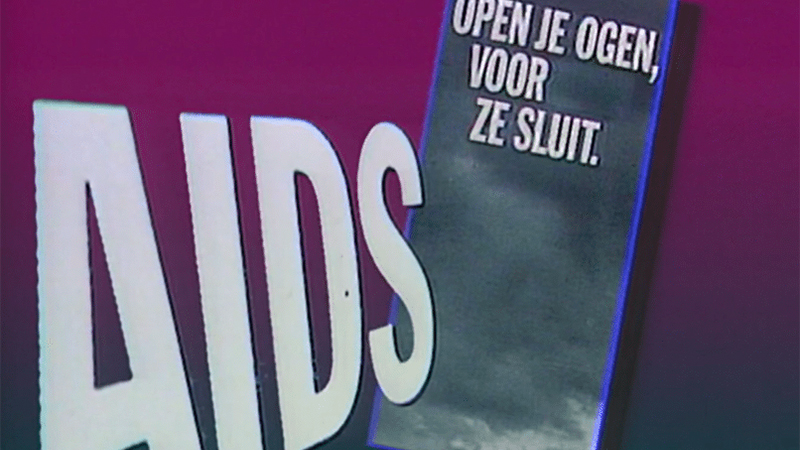
The HIV virus spread rapidly and caused panic among the population in Flanders. Several countries launched prevention campaigns to prevent the number of infections from spiralling out of control. Such campaigns focused mainly on the principal means of prevention for HIV: the condom. A contraceptive that Catholic Flanders viewed with considerable distaste. At the time there was still a strong tendency to push contraception into a dark corner, often rooted in outdated Catholic views. Sex was considered legitimate only when directed toward procreation—everything beyond that was regarded as sinful. This was already an obstacle in itself, but the fact that the disease initially affected mainly homosexual men generated even more resistance.
Just when it seemed that homosexuals were beginning to integrate more fully into society, the epidemic pushed the community backwards again. AIDS was seen as a disease spread by the “objectively disordered,” as described in the Catechism of the Catholic Church (see paragraphs 2357–2359). Many questions arose concerning the acceptability of homosexuality, because it was supposedly ‘the cause’ of the disease. Many people interpreted the epidemic as a punishment or revenge from God. That was deeply confronting: genuine love was supposedly wrong, and if you gave in to it, you would be punished.
Flanders versus the condom
Among the AIDS patients I met in my practice, I often noticed deep shame. They experienced conflicts with their families and struggled with guilt and fear simply because they had contracted a disease surrounded by enormous taboo. But the difficulties were not limited to their private lives. Within the healthcare system itself I witnessed things that left me speechless. Many doctors and healthcare workers were afraid to treat AIDS patients for fear of infection. Some tried to avoid providing care, made treatment difficult, or implicitly blamed patients for their illness.
This attitude was rooted in a society permeated by conservative Catholic thinking. In the 1980s Flanders was strongly pillarized: between 1950 and 2000 the Christian Democratic Party (CVP, now CD&V) participated in every government. That translated into enormous resistance to campaigns promoting condoms as a preventive measure. Every attempt in that direction met opposition from Catholic circles. And yet, looking back today, I also see another side: the great willingness of many people who, despite everything, chose to help and protect others.
Panic reactions and misconceptions
Whenever a new and unknown disease appears, panic inevitably arises. People talk over one another, conspiracy theories emerge, and someone must be blamed. Fear feeds judgment. If the disease is linked to subjects such as sex or homosexuality, the reaction becomes even stronger. The AIDS outbreak offered the Church an opportunity to portray homosexuality as the “great sin.” Many believers took this literally. Fortunately, the 1980s also contained another reality: solidarity and progress. A large part of society eventually responded in a humane and meaningful way. The Church, by contrast, began to fragment—and not without reason. Its reaction to the epidemic was, objectively speaking, misguided.
Fighting AIDS together
Outraged by the way parts of society reacted, I decided to set aside my career as a general practitioner and devote myself fully to AIDS activism. In 1986 I closed my practice in Uccle and began a new chapter: literature and activism. Despite the many prejudices, I increasingly saw solidarity grow. People realized that something had to be done because we literally saw others wasting away: young people, older people, intelligent and beautiful people. The victims did not all die at once, but the situation felt catastrophic. In a short time countless patients deteriorated without any available treatment.
At that moment we could not yet imagine that the first medications would appear so quickly, nor that the emancipation of the gay community would accelerate dramatically. This social transformation unfolded unexpectedly fast, partly thanks to the solidarity that developed in Flanders. Schools allowed us to speak about condom use, volunteers worked to create understanding for HIV patients, and scientists continued searching for answers. Gradually, during the 1990s, AIDS became a treatable condition with which people could live. In that sense the comparison with the COVID pandemic is not so far-fetched.
Recente bijdragen
Is the use of ADHD medication helpful and safe in children?

Is the use of ADHD medication helpful and safe in children? Reading time: 4 minutes. This article contains general information and does not replace […]
School and Homework for Children with ADHD

School and Homework for Children with ADHD Reading time: 4–5 minutes. This article provides general information and does not replace professional […]
As a parent, how do you support your child with ADHD?

Busy behavior, difficulty concentrating and becoming easily overstimulated: these are typical challenges in children with ADHD. With a few practical […]

Over de auteur

Other works by our writers
- February 2026 (1)
- December 2025 (2)
- November 2025 (2)
- October 2025 (6)
- September 2025 (4)
- August 2025 (12)
- July 2025 (2)
- March 2025 (3)
- December 2024 (10)
- November 2024 (6)
- October 2024 (2)
- April 2024 (31)
- February 2024 (1)
- January 2024 (3)
- December 2023 (1)
- February 2022 (2)
- May 2021 (1)
- February 2021 (3)
- January 2021 (5)
No comments have been posted yet!